
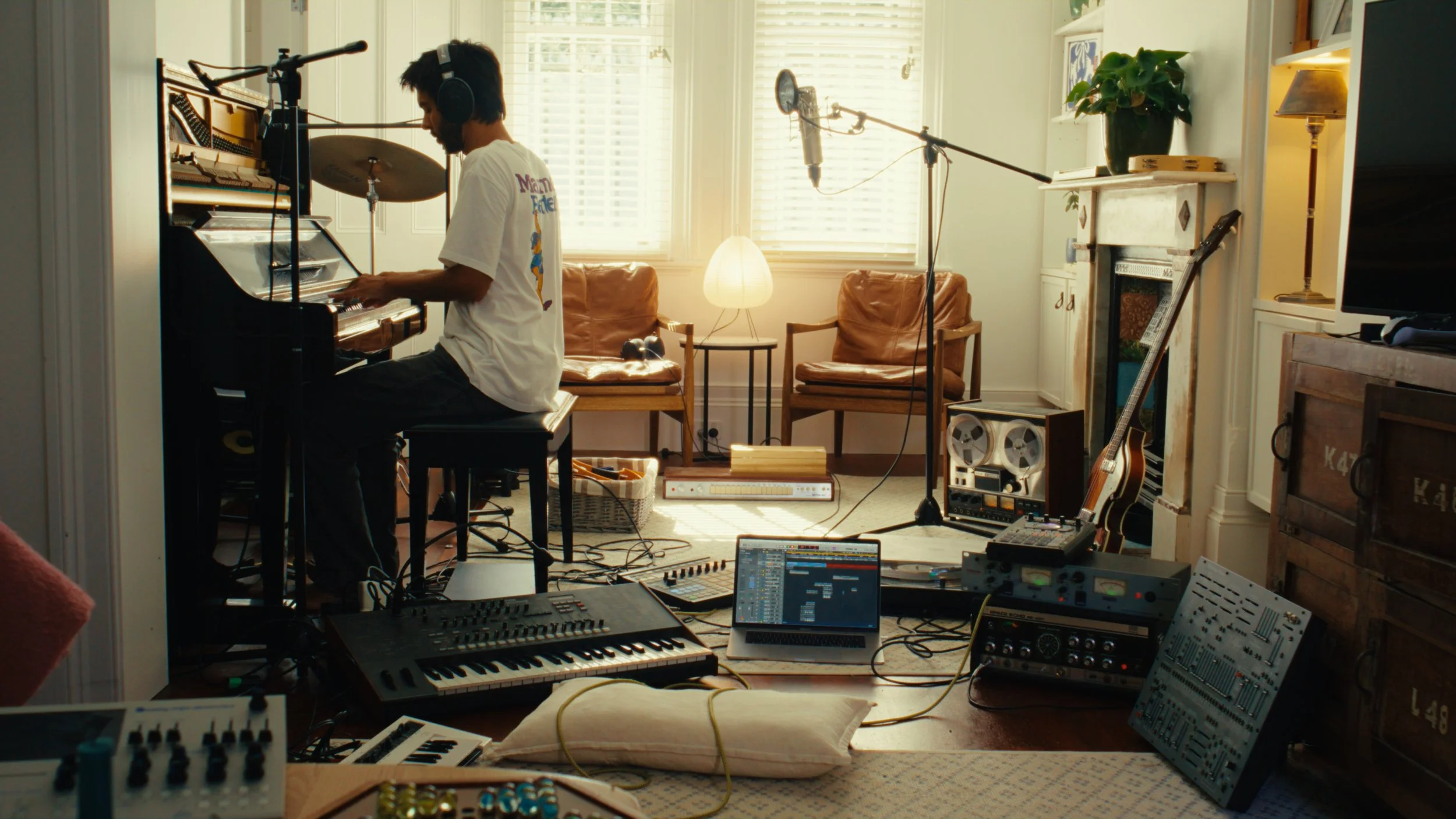
THE PROCESS: Jerome Blazé
Words: Kylie O’Connell
Photo credit: James Tarbotton
There’s a real spaciousness to the music that Sydney-based artist Jerome Blazé creates. Having studied contemporary music at the Sydney Conservatorium of Music, where he now teaches, his sound is both expertly produced and emotionally expansive.
It’s music that cannot be easily defined by genre, particularly in the sense that he uses collaboration as a constant tool for exploration. But the feeling is always consistent, a warm, confident sound that envelopes you—where classical instrumentation inspires depth and electronic soundscapes provide an exciting edge.
Fresh off the back of a show in Melbourne at the much-loved Punters Club, which, as luck would have it, was booked for the same day as Courtney Barnett’s free pop-up gig, our chat immediately began by praising the local Victorian music scene: the appetite, the enthusiasm, the buzz, and the many local pubs that facilitate emerging music as a core part of their offering. But we soon shifted back to something a lot of people have been speaking about lately. There’s a level of excitement bubbling away in Sydney too, one that hasn’t been as present in recent years. The city feels alive again.
I wanted to chat to Jerome for numerous reasons. His sophomore LP Living Room (2024) is a beautifully layered mix of warming lyricism, glitchy soundscapes, and stunning string arrangements that really captured my attention. It’s an album that gets better with each listen; intricate details emerging with every new spin. He’s also earnt himself an impressive roster of producer credits with the likes of Nick Ward, Thandi Phoenix, FRIDAY* and more. But mainly, I was intrigued to learn more about his creative process.
A big fan of sampling, usually friends’ music, and field recordings, Jerome’s unique approach often leans into the idea of ‘place’ as direct inspiration. Field recordings are a foundational component of Jerome’s music, “I've always used a lot of field recordings in my music, even pre-Living Room, which was very much trying to capture a place in a more specific way. But even as a textural element before that, I'm always drawn to things that make things feel more alive, especially if you're making music on a computer.” If you take a look at his Instagram page (@soundbyjerome), you will find a series of videos of him out in the wild, recording in real time—whether it’s the sound of Central Station, Hyde Park, or a flock of pigeons taking flight, which he assures me is a really cool sound. There’s also some refreshingly sweet interactions with curious members of the public, but largely, for him, this video series is a practice of being present.
“The other thing with this is it's almost like a mindfulness exercise, not to get too yoga about it. There are times when I've done it and I've come in with too much preconception. I think they work out the best when I just sit back and allow space, and allow myself to just try and feel really present and immersed. The thing I love with field recordings is that they're so, I guess, idiosyncratic. It's like no one else is ever going to have that sound.”
While Living Room has numerous field recordings throughout (chirping birds, sirens, city soundscapes), the relationship between place and sound isn’t always quite so literal. Jerome has mentioned in numerous interviews that the album ‘sounds like Sydney’. But of course, it’s very much from his own perspective. Originally from the Southern Highlands, only a reasonably short 90-minute drive from the city, it’s actually this idea of motion that he’s referring to. Jerome explained, “There's certain chords that I gravitated towards for the album that all had this perpetual motion to them, they felt like they were away from landing and sitting. I don't know if that is something that's intentional, but I didn't grow up in Sydney. And maybe that feeling of not being home sort of found its way into the chordal language of the album.” It’s this particular lens on place that’s most interesting—how location, timing and personal experience all align to impact creative output.
As its title suggests, Living Room was produced and recorded in his living room, which is ironic given just how grand the record feels. It makes sense when a DIY pop artist tells you their album was recorded in their bedroom, but this almost appears misplaced—in a wonderful way—like the orchestral charm would have needed to be recorded in a large studio with engineered acoustics. One of the lyrics, ‘The living room/It holds me’, triggered a thought about the impact of making music in such a familiar place, and how that increased level of comfort might influence a song's direction. “It's very easy to not feel relaxed when you're making music. Or at least when I'm making music. Sometimes it's kind of stressful, because you sort of hype yourself up. So being in a space that is very comfortable and very homely was important for that.” This, combined with the harmonies, piano, and strings allows the album to wrap around you like a big embrace.
It’s testament to Jerome’s level of expertise, and no doubt his community of featured collaborators who he either met at The Con or through its wider network. Much like field recordings, collaboration is just as foundational to his craft. His most recent single ‘You Can Find Us Out Your Way’ is a beautiful track that features a sample from Australian string arranger Alex Turley (who has worked with Dan Sultan, Genesis Owusu, Emma Donovan and Lime Cordiale, to name a few). It seems like Jerome has landed on a very specific recipe for a very refreshing sound—one that is both forward-thinking and forever fresh, given his collaborative approach.
“I think it just feels essential. I do make music in a very electronic way, in that it’s on my laptop and a lot of it starts with me by myself. I don't really co-write much, but I do in the sense of, further down the process, instrumentalists adding their own voices. So that's co-writing in a way, but the genesis of the songs are usually made by myself. Having that step later in the process is so important to make the music feel like it's outside of me and more collaborative, and open the songs up to give me things that I just wouldn't do myself, and wouldn't expect.”
What’s most striking about this music is that it pulls back in all the right places. Whether by design or not, it gives you freedom to think—enough space to let the instrumentals do a lot of the talking. It’s dynamic, honest and reflective.
And while we’ve leant into Sydney hard on this article, Jerome shared that he has his sights set on London, a city he finds particularly inspiring for its pure abundance of live music. With travel and a third LP currently in the works, the future is looking bright.
Listen here and below.